Centium AI and Ski Area Management Study the Summer Discoverability Gap
New Centium AI and Ski Area Management research finds ski resorts appear in 87 percent of winter AI travel answers but only 51 percent in summer.
Centium AI partnered with Ski Area Management, the ski industry's leading trade publication, on new research measuring how often mountain resorts surface when travelers ask AI chatbots where to go in the summer. The study, authored by Centium AI Founder Michael Rueckert and published in Ski Area Management's July 2026 issue, found that a ski area appears in 87 percent of winter travel answers but only 51 percent of summer ones, a discoverability gap that widens exactly as the summer booking conversation begins.
How the study worked
The two ran 345 brand-neutral trip-planning prompts across the five major AI models, ChatGPT, Claude, Gemini, Perplexity, and Grok, in May 2026, generating 1,725 responses. No prompt named a ski area. Instead the prompts asked the kinds of questions a traveler actually asks, like the best places for a family vacation in the Pacific Northwest, and the study measured whether a resort surfaced in the answer. Winter benchmark prompts mirrored the summer ones so the two seasons could be compared directly.
The winter-to-summer visibility gap
The gap is not a quality problem. An AI answer names about 10 destinations on average in either season, but in summer the field explodes. National parks, free public trails, gateway towns, and roadside attractions all compete for those slots, so the ski industry's share of named places collapses from 40 percent in winter to 13 percent in summer. Public lands and nature roughly double their share, from 19 percent to 39 percent, and become the loudest voice in the room. National parks claimed seven of the ten most-mentioned destinations in the entire study. Whistler Blackcomb, in fourth, was the only resort to break into that group.
“
A resort competing in winter is competing against other resorts. In summer, it is competing against an entire region's worth of things to do, most of which are free, famous, and evidently, already top of mind for the model.
Michael Rueckert, Founder of Centium AI
The pattern held across all five models, which points to their similar training data. Gemini was the most generous to resorts, naming one in 68 percent of summer answers, while ChatGPT was the toughest room at 37 percent. A resort missing from one tool is usually missing from the next. Regionally, the Northeast was the bright spot, with resorts surfacing in 83 percent of summer answers against 87 percent in winter, because it faces the thinnest field of rivals: its summer answers name just one national park, Acadia, against the six to 12 named for the western United States and Canada. In the West, the miss is often a case of the destination eclipsing the resort. Models answer with Lake Tahoe or Whistler rather than the ski areas inside them. Counting those destination mentions as partial credit lifts summer resort visibility from 51 percent to 59 percent, a signal that in summer the resort brand and its destination read as separate entities to the model.
What resorts own, and what they don't
Cross-regional prompts split cleanly into what resorts own and what they do not. Where a resort has built the infrastructure, it wins. Mountain biking questions surfaced a resort 89 percent of the time, mountain adrenaline questions like coasters and zip lines 67 percent, and family mountain adventures 60 percent. The picture inverts on high-funnel questions. Broad national summer vacation planning named a resort just 21 percent of the time, the weakest of any theme, with wellness at 25 percent and culinary and cool-weather escapes at 33 percent. Resorts appear once a traveler already knows they want to ride a bike or a coaster. They are barely visible while that traveler is still deciding where to go at all.
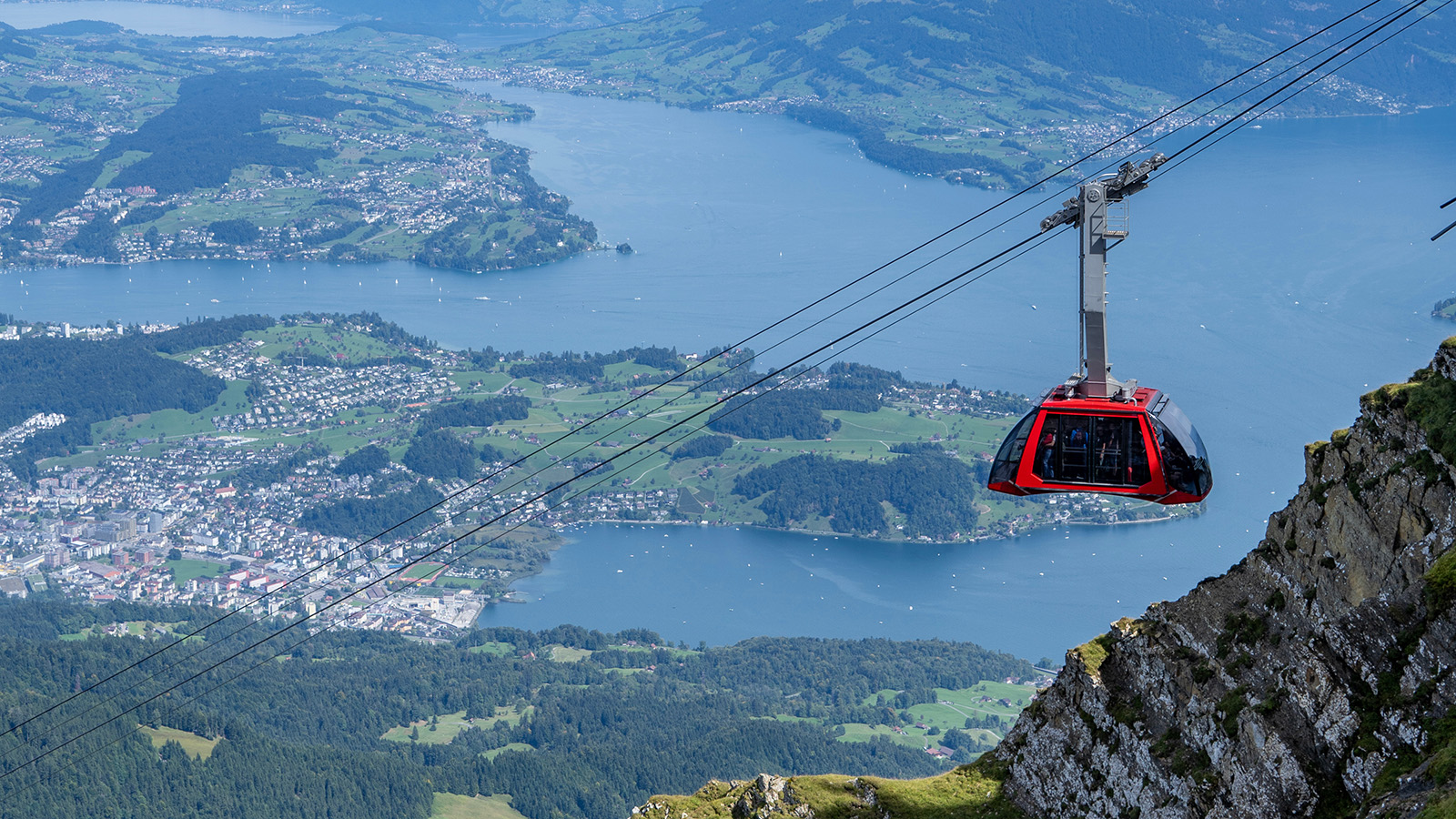
An aerial tram ascends Mount Pilatus above Lucerne, Switzerland. Lift-served experiences are the assets a resort owns, and they are where resorts hold up best in AI summer answers. Mountain biking questions surfaced a resort 89 percent of the time, and mountain adrenaline activities like coasters and zip lines 67 percent.
Where AI finds its answers
Sourcing followed the same logic. Across the study the models referenced more than 3,100 websites, and the single most-referenced was the National Park Service, whose nps.gov appeared in 199 answers, more than any resort, tourism board, or magazine. Resort-owned websites carried real weight on narrow winter questions, about 27 percent of referenced sites, but that share fell to 20 percent on regional summer questions and 15 percent on broad national planning. At the page level, the documents AI leaned on most were roundups and rankings, led by a Marriott travel guide to the best summer mountain resorts. Earning a place on those ranked lists is a media-relations discipline, not a web-maintenance one.
What it means for resorts
The finding echoes what Centium AI measured in its study of how AI recommends running brands: across categories, AI leans on third-party validation, and a brand's own website is rarely where the answer comes from. Centium AI, founded by a former ski-industry marketer, works with more than two dozen tourism boards and a wide roster of outdoor and destination brands, and the summer study points its ski clients toward the same playbook. Lean into the activities resorts own, earn placement in the regional things-to-do content AI reads, and get named alongside the destinations the model already trusts rather than competing against them.
The full research, including the regional breakdowns and the activity-by-activity data, runs in Ski Area Management's July 2026 issue, with a follow-up article, "The Summer Playbook," planned for a future issue. Centium AI measures how the six major AI models recommend brands and destinations and surfaces the exact sources each one weighs most, so an operator can see where it stands and what to do about it. See how it works at Centium for Destinations.
Pick a plan and see your first dashboard today, or try our free tools to explore the platform in action. You’re just a few clicks away from building your customized methodology.